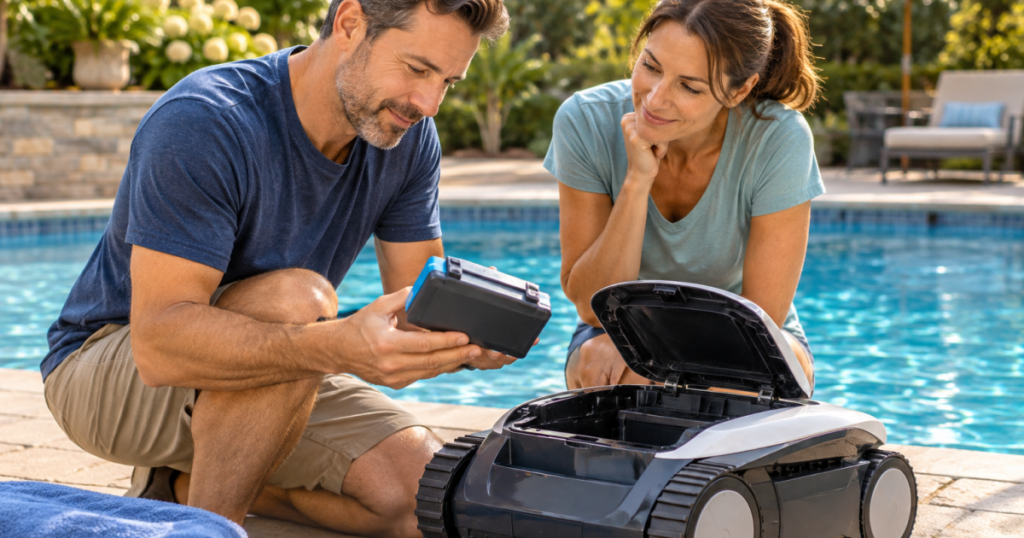
A cordless cleaner feels brilliant right up until the robot comes back early, refuses to charge, or loses the appetite for a full pool run. That is where cordless pool robot battery replacement can be worth it, but only when the battery is the actual failure point, the repair preserves the watertight seal, and the cost lands well below a sensible replacement threshold. The awkward part is that many sealed cordless cleaners are not designed like cordless drills with easy snap-in packs.
Battery pack replacement, internal diagnosis, seal replacement, and charging-system repair should be handled by the manufacturer, an authorized service provider, or a qualified electronics repair professional so the cleaner remains compliant with applicable electrical safety standards and local requirements.
What to know first
The short answer: replace the battery if the robot is otherwise healthy, the repair comes through a proper service path, and the total cost is low enough to beat buying a current replacement. Buy a new robot if the cleaner is already dated, has water intrusion, needs multiple wear parts, or the battery is not officially serviceable.
A battery is only one part of the ownership equation. Cordless robots also depend on clean filters, free-spinning brushes, sound tracks, reliable charging contacts, intact seals, and a pool routine that does not overload the cleaner every cycle. A robot can remove a lot from weekly upkeep, but it is still part of a system; the broader split is covered in what a pool robot really takes off your weekly cleaning list.
Step 1: Make sure the battery is really the problem
A tired battery usually shows up as shorter runtime, failure to complete a normal cleaning cycle, shutdown soon after launch, or charging behavior that changes suddenly. Those symptoms matter, but they are not proof by themselves.
Before you price a repair, run the boring checks. They are boring for a reason: they save money.
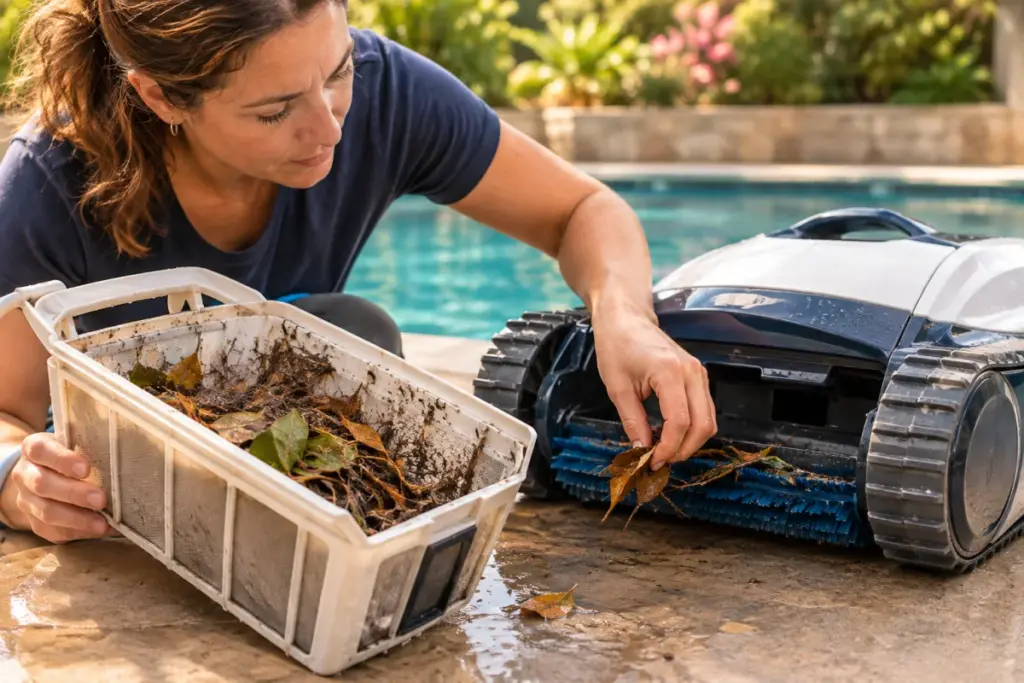
- Clean the filter basket or cartridge fully. A clogged filter makes the robot work harder and can make a good battery look weak.
- Check the brushes, tracks, and intake. Pebbles, palm seeds, stringy leaves, hair, and toy fragments can increase drag.
- Inspect charging contacts and the charger. Dry, clean contacts matter. A charger fault can masquerade as battery failure.
- Look for water inside the robot or fogging behind panels. Water intrusion changes the decision; battery replacement alone may be throwing good money into a damp little submarine.
- Compare behavior across two or three normal cycles. One bad run after a storm or heavy leaf drop is not the same as a battery nearing the end of useful service.
Step 2: Use the brand’s service path before opening anything
Most cordless robotic pool cleaners use sealed battery compartments because they live around water, vibration, heat, and chemicals. Even when replacement packs exist somewhere online, that does not mean the robot was designed for owner battery swaps.
Start with the brand or retailer support route. Have the model name, serial number, purchase date, proof of purchase, charger details, and a plain description of the symptoms ready. Ask three direct questions:
- Is the battery replaceable on this exact model?
- Is the repair handled under warranty, flat-rate service, parts replacement, or full unit exchange?
- Will the repair include seal inspection or resealing after the battery work?
That last question matters. A successful cordless pool robot repair is not just about getting the battery to charge. It is about returning the cleaner to a water-resistant condition that can survive real pool use.
Brand-by-brand serviceability snapshot
Published service options vary by model, purchase channel, region, warranty status, and model year. Treat this as a decision map, not a promise that a given battery pack is available for retail purchase.
- Aiper, including models such as Scuba S1 and Scuba X1 Pro Max: Use Aiper support or the original retailer first. Battery access should be treated as a manufacturer or service issue unless the manual for your exact model says otherwise. Storage habits matter: avoid leaving the robot fully depleted, keep it out of direct heat when stored, and follow the charging guidance in the manual.
- WYBOT, including C1-series cleaners: Confirm the warranty path and whether repair is handled by parts service, replacement unit, or return authorization. If the cleaner also needs tracks, brushes, or a charger, total repair value drops quickly.
- Dolphin by Maytronics LIBERTY models: Start with Maytronics or an authorized dealer/service route. For higher-end cordless cleaners, authorized diagnosis is especially important because battery, charging, drive, and sealing issues can overlap.
- Polaris cordless models: Use the brand support path and verify whether battery-related issues are covered by warranty or handled through service. Do not assume packs are owner-swappable unless the documentation says so.
- Beatbot cordless models: Check the current support terms for the exact model and generation. Smarter, more integrated cordless designs can make unauthorized internal repair less attractive.
If you are comparing whether an older robot is still worth keeping against current cordless options, the Cordless Pool Robot Model Tracker is the better next stop than guessing from stale listings.
Step 3: Put the repair quote through a replacement test
Once you have a real repair path, judge it against the whole robot, not just the battery. A simple threshold works well:
- Usually worth considering: the robot is still a good fit for your pool, there is no water intrusion, wear parts are in decent shape, and the total repair cost is less than roughly one-third of a comparable current replacement.
- Maybe worth it: the repair cost is around one-third to one-half of a comparable replacement, but the cleaner is a premium model, coverage still suits your pool, and the service includes proper resealing.
- Usually not worth it: the quote approaches half the cost of a new comparable cleaner, the model is already frustrating in your pool, or the robot also needs brushes, tracks, seals, charger parts, or drive repairs.
That percentage test is editorial judgment, not a manufacturer rule. It works because cordless pool robots are improving quickly. Paying heavily to revive a model that already struggles with your shelf, slope, steps, or debris pattern can lock you into yesterday’s compromise.
Step 4: Factor in pool fit before spending on repair
A battery repair makes the most sense when you still like the robot. If the cleaner regularly misses one end of the pool, bogs down in leaves, stalls near transitions, or cannot handle your waterline expectations, a fresh battery only makes the same frustrations last longer.
Ask these pool-fit questions before approving work:
- Does the robot still clean the zones you actually care about?
- Has your debris pattern changed because of landscaping, storms, shade, pollen, or nearby trees?
- Are filters, baskets, and brushes still easy to find?
- Would a current model give you a better retrieval method, coverage style, or maintenance routine?
- Are you repairing a good robot, or are you emotionally negotiating with a sunk cost?
That last one is where pool gear gets sneaky. A working robot feels like an appliance; a failing one becomes a hobby.
Step 5: Protect the next battery, repaired or new
Battery life varies with chemistry, usage, heat, charging routine, storage, and how hard the robot works. No responsible blanket lifespan fits every cordless pool cleaner. The goal is to avoid the habits that shorten useful life early.
- Store the robot in a shaded, dry place instead of baking it on open pool decking.
- Rinse and dry the cleaner as the manual directs before longer storage.
- Do not store it for long periods with a fully depleted battery.
- Clean filters after cycles so the motor and pump are not constantly working through loaded media.
- Keep charging contacts clean and dry before charging.
- Follow the manufacturer’s off-season charging instructions rather than improvising.
For a new cleaner, build those habits from the first week. A simple learning routine like your first three robot cleaning cycles helps you spot normal behavior before you have to diagnose abnormal behavior later.
Questions people ask
Can you replace a cordless pool robot battery yourself?
Sometimes owners find replacement packs online, but that does not mean self-repair is wise. Because cordless pool robots operate in water and rely on sealed electronics, battery replacement is typically better handled through the manufacturer, an authorized service provider, or a qualified repair professional.
Is battery repair covered by warranty?
It depends on the brand, model, purchase date, warranty terms, and diagnosis. Start with the official support path before assuming the battery is excluded or covered.
Should you replace the charger before the battery?
Only after diagnosis. A charger or contact problem can look like a failed battery, but buying parts at random is a poor troubleshooting strategy unless support identifies that part as the likely cause.
Key takeaways
Battery replacement is worth it when the cleaner is otherwise sound, the repair is properly sealed, and the quote is comfortably below the cost of a current replacement. It is not worth it when the robot is leaking, outdated, poorly matched to your pool, or headed for a stack of additional repairs.
Pool Robot Report may earn from qualifying purchases when readers use some product links; the full policy is explained in the affiliate disclosure.